I grew up going to the pool and the beach every single year. My father was a swim coach, and still is, so being comfortable in the water and learning how to swim was one of the first skills I learned in life. It shaped how I think about water safety as a parent, and it’s something I have prioritized with both of my daughters from the time they were babies.
Swimming is not just a fun summer skill, it is a life skill. Drowning is one of the leading causes of accidental death in children under five, with thousands of preventable incidents happening every year in the United States alone. The good news is that early, positive water exposure combined with the right flotation support makes a real difference in building water confidence and eventual swimming ability.
Ideally, every child would get into swim lessons as early as possible, and I genuinely recommend that. But the reality is that once-a-week swim lessons are not enough on their own. Getting to the pool or beach regularly, and letting your child feel the water in a supported and safe way, is what actually builds the connection between lessons and confidence. That’s where flotation devices come in.
My favorite way to introduce kids to water is through age-appropriate flotation devices that give them a little independence while keeping them safe. Over the years I’ve used several with both of my kids, and I want to share what worked, what didn’t, and how to choose the right one for where your child is right now.
One important note before we dive in: flotation devices are not life jackets and they are not a substitute for adult supervision. No matter how good the floatie is, your child should always be within arm’s reach and you should always be watching. A flotation device is a tool for building water confidence and pre-swimming skills, not a replacement for your presence.
When Should You Start Introducing Your Child to Water?
My honest recommendation is to start swim lessons as early as your pediatrician supports it, and many now encourage starting around your child’s first birthday. The American Academy of Pediatrics has updated their guidance to reflect that swimming lessons can benefit most children starting at age one, and some programs like Infant Aquatics and ISR (Infant Swimming Resource) work with babies even younger than that. The earlier you start, the more natural the water feels to them as they grow.
That said, you do not have to wait for formal lessons to begin building water confidence. You can start as early as a few months old with something as simple as bath time. Both of my babies loved the tub from early on, and that comfort with water, the splashing, the sounds, the sensation, carries right over into the pool. Normalize water early and the transition to swimming tends to be so much smoother.
Even once lessons begin, once-a-week classes are rarely enough on their own. Regular time at the pool or beach, in a supported and safe way, is what actually builds the connection between what they are learning in lessons and real water confidence. That is exactly where the right flotation device comes in!
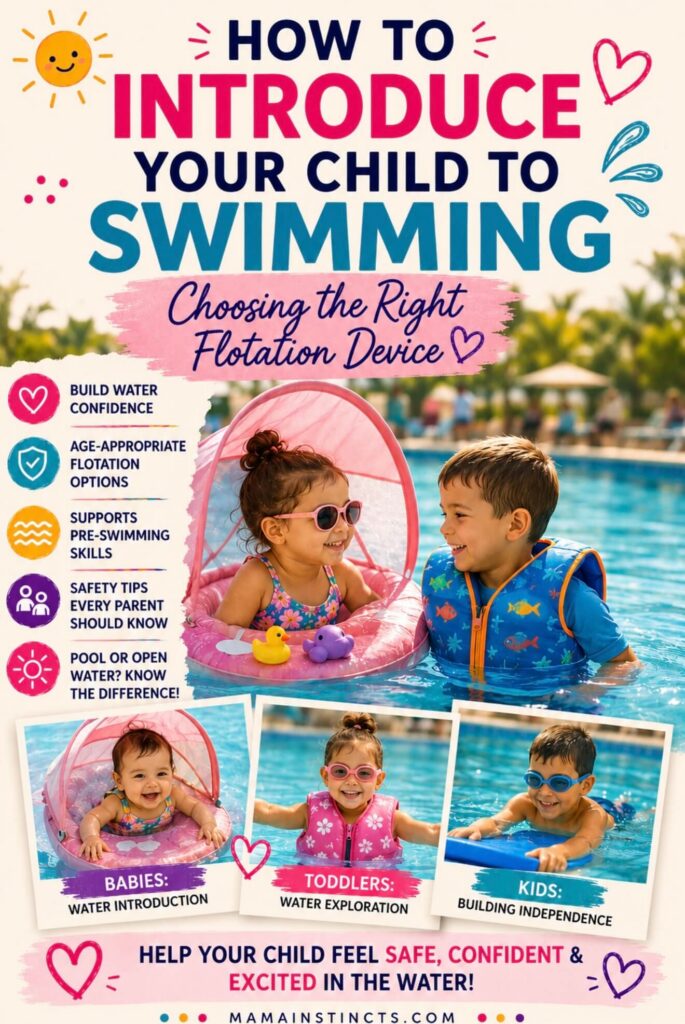
Stage 1: Babies – Water Introduction
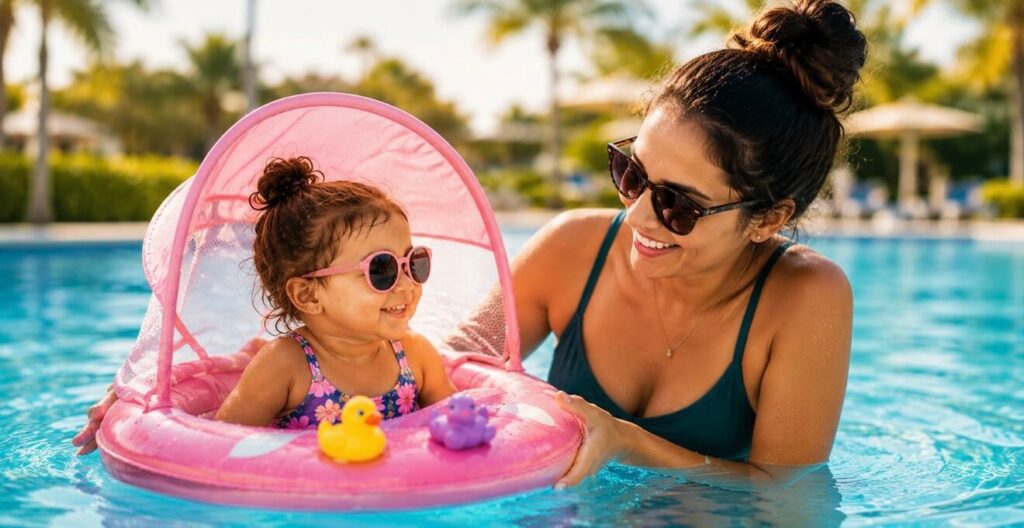
The goal at this stage is simple: get your baby comfortable being in the water. You are not teaching them to swim, you are helping them fall in love with it. Keep the energy relaxed and playful, bring a few bath toys or pool toys to make it fun, and let your baby lead the way.
The floatie I used with both of my girls as babies, and that I recommend for this stage, is a baby spring float. It sits your baby upright in the water with a fabric seat and spring frame, so they can feel the water all around them without being submerged. What I loved most was how compact it folds down, which is perfect if you travel with it, and ours went all the way to the beaches in Costa Rica and back. We used the same one for both girls and it held up beautifully!
I used to put little bath toys on the mesh part to keep them entertained, but honestly their favorite thing was just splashing. Let them splash, let them feel the water, let them get messy with it. That sensory experience is everything at this age!
Tips for the baby stage:
- Always hold the float steady and stay close, never leave your baby unattended even for a second.
- Keep pool time short at first, 15 to 20 minutes is plenty for young babies.
- Apply a baby-safe mineral sunscreen before heading out, even on cloudy days.
- Dress baby in a SwimZip swimsuit for boys and girls. I’ts the easiest way to protect from sun exposure without relying solely on sunscreen!
- Make sure the water temperature is comfortable, around 84 to 86°F is ideal for babies.
- Pack a hooded baby towel for quick warmup after.
Stage 2: Toddlers – Water Exploration and Pre-Swimming Skills
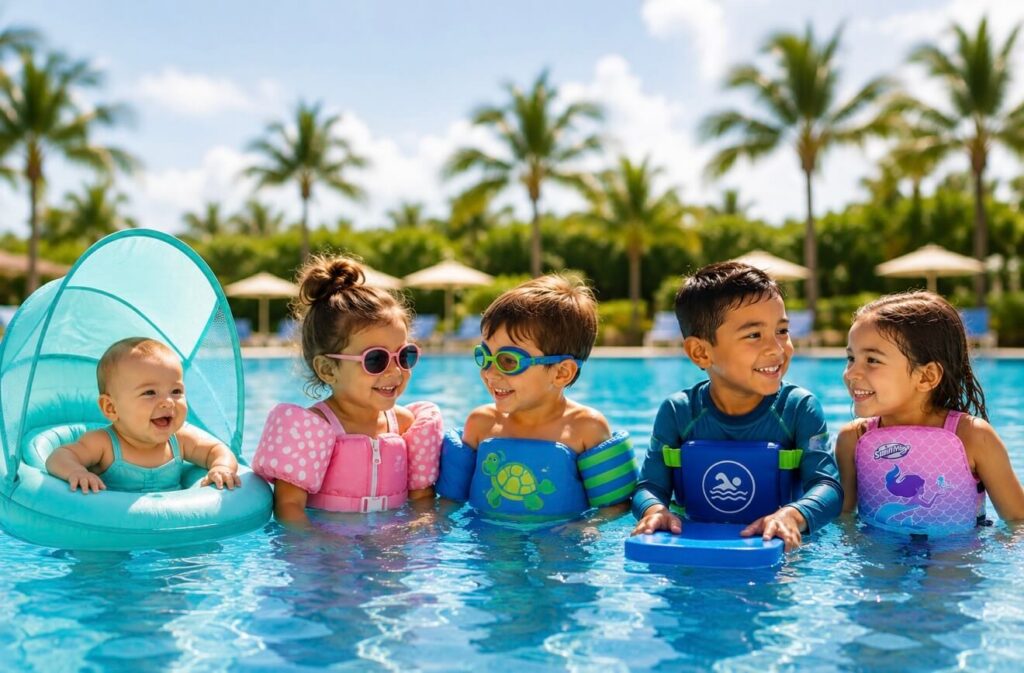
Once your baby has outgrown the baby float and is ready for more freedom in the water, it is time to move up to something that lets them paddle and kick and actually move around. This is one of my favorite stages because you can really see their personality in the water come through!
There are two main options at this stage, and the right one depends on your child’s size and comfort level.
Swim Vest | Puddle Jumper
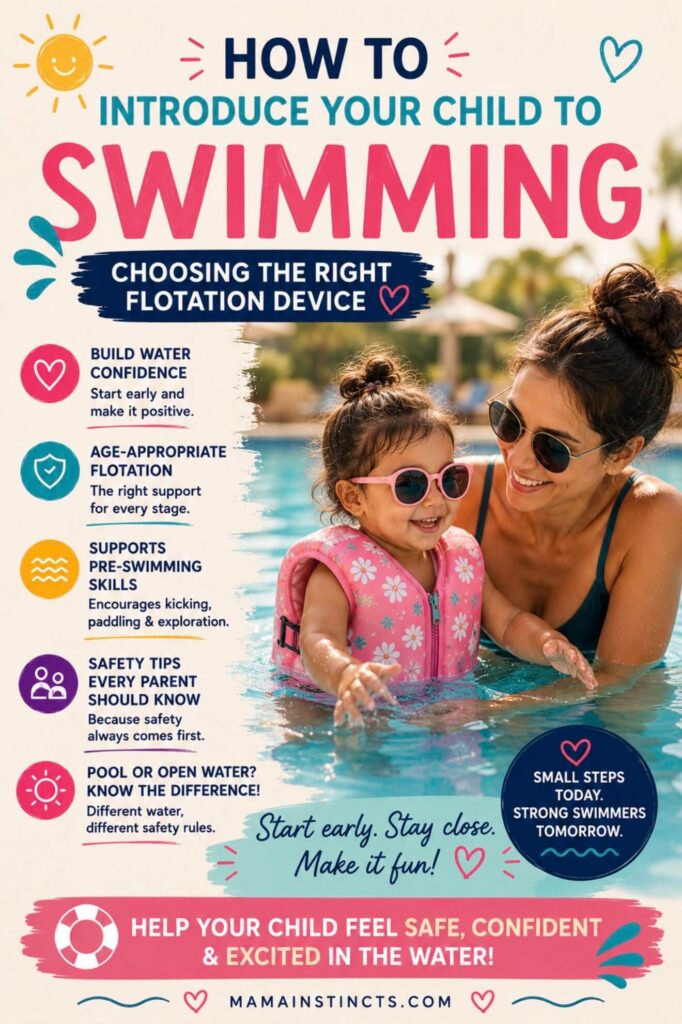
A swim vest or puddle jumper (my personal preference is this one) is probably the most familiar option at this stage. It’s a vest with foam panels that zip or clip up the front, keeping your child upright and afloat while still allowing them to kick and move around. One thing I love about the vest style is that you can find them with UPF 50+ fabric, which gives you an extra layer of sun protection while they’re in the water.
My oldest went through a phase where she was nervous in the pool and would cling to me every time we got in. The swim vest was what finally gave her the confidence to let go, because she could feel herself staying afloat on her own. Once she realized the vest had her, she never looked back.
Swim Sweater
A swim sweater goes on over your child’s head like a shirt and inflates with a pump. Because it goes over them rather than clipping on the front, kids truly cannot slip out of it, which I love from a safety perspective. It also sits differently on the body than a vest, making it easier for children to lean forward naturally and start practicing a swimming position.
My youngest was the complete opposite of my oldest, she wanted out of the baby float almost immediately and was trying to swim on her own before she knew how. The swim sweater was perfect for her because it gave her the freedom to move all over the pool independently. She was doing bubbles on her own within weeks of using it because she realized she could put her face in the water and the float would keep her up.
One practical note: the swim sweater style typically inflates with a standard pump like a bike pump, and once inflated you can leave it that way all season since it holds air well. No fumbling with it every pool day.
Great additions for the toddler stage:
- Pool toys and dive rings to throw and let them swim toward, great for building kicking skills.
- Kids swim goggles to encourage face-in-water comfort.
- Non-toxic kids sunscreen (or this one for the more active kids) reapplied every 80 minutes while in water.
- Rash guard for extra sun protection.
Stage 3: Kids – Swim Training and Building Independence
Once your child is feeling confident in the water and is actively taking swim lessons, it’s time to move toward tools that support actual swimming skill development rather than just flotation. The goal here is to gradually reduce the amount of support so your child is doing more of the work on their own.
Adjustable Swim Trainer
An adjustable swim trainer sits at your child’s chest and back with removable foam floats. The genius of this design is that you can remove floats one by one as your child gets stronger, so the device grows with their skill level.
When we first started using one with my oldest, she had all the floats in and still needed a lot of support. As her lessons progressed and she got stronger, we removed them gradually until she was swimming on her own.
This is also a great option when you’re watching two kids at the pool at the same time and need your older child to have a safety layer while you’re helping your younger one. It gives them just enough support without doing all the work for them.
Kickboard
A kickboard is a classic swim training tool that lets kids hold onto the board while kicking their legs to move through the water. It isolates the kick, which is one of the most important fundamentals of swimming, and kids love the independence of propelling themselves across the pool. Most swim instructors use these in lessons, and having one for pool time reinforces what they’re learning in class.
Great additions for the swim training stage:
- Swim cap: especially helpful for kids with longer hair or taking regular lessons.
- Swim goggles: essential at this stage for underwater confidence.
- Diving gems: keeps them entertained for a while! Start in the shallow end, and progress to the deeper end as their swimming skills progress.
- Underwater camera: perfect for encouraging kids to put their face in the water and build underwater confidence.
A Note About Open Water: When You Need a Life Jacket
Everything above applies to pool use. Open water is a completely different situation, and this is important to say clearly: for boats, lakes, rivers, or ocean swims where your child may be in deep or moving water, a US Coast Guard approved life jacket is non-negotiable, no matter how well your child can swim in a pool.
A USCG-approved kids life jacket is rated to keep a child’s head above water even if they are unconscious, which no pool floatie or swim vest is designed to do. If you spend time on boats or near open water, this is a must-have and should be worn any time your child is near or on the water, not just when they are actively swimming.
Water Safety Tips Every Parent Should Know
No flotation device replaces these. Keep these on your radar every single time you are near water with your child.
- Designate a water watcher: When multiple adults are present, assign one person at a time whose only job is watching the kids in the water. No phones, no conversations, just eyes on the water.
- Teach your child to ask before entering water: This is a habit that could save their life.
- Never rely on floaties as a substitute for supervision: Flotation devices can deflate, slip off, or flip a child face-down in seconds.
- Enroll in swim lessons as early as your pediatrician recommends: The American Academy of Pediatrics supports swim lessons starting around age one for most children.
- Know CPR: Take a pediatric CPR course, many community centers and hospitals offer them free or low cost.
- Have pool barriers at home: If you have a home pool, a four-sided fence with a self-latching gate reduces drowning risk significantly.
What If Your Child Is Afraid of the Water?
The most important thing to remember is that fear is information, not opposition. Your child is not being dramatic or difficult. Their nervous system is telling them something feels unsafe, and the way through that is not to push past it but to rebuild the feeling of safety slowly, one small step at a time.
Forcing a child into the water before they are ready almost always makes the fear bigger, not smaller, because it teaches their nervous system that the water is somewhere they lose control. Patience here is not weakness, it is strategy.
Some children also respond really well to having a say in the process. Let them decide when they are ready to go one step deeper, when they want to try putting their face in, when they feel okay letting go of your hand. That sense of agency is often what breaks the cycle of fear faster than anything else.
Here is what helped us and what I recommend:
- Never force it. Let them lead the pace and celebrate every small step, even just dipping toes in.
- Start in a shallow area where they can stand, so they feel in control.
- Use water play at home, sprinklers, water tables, the bathtub, to rebuild positive associations.
- Let them watch other kids in the water before they get in themselves.
- Look for a swim instructor who specializes in nervous or water-fearful children, it makes a world of difference.
- Pool toys and water games can make the pool feel playful and fun rather than intimidating.
The goal is never to push through fear, it is to build enough positive experiences that the fear gradually loses its grip. Give it time!
The Bottom Line
As a parent, your most important job when it comes to swimming is making the water feel safe and fun. Not forcing it, not rushing it, just showing up consistently and letting your child build their confidence at their own pace. The right flotation device for your child is the one that matches where they actually are, not where you wish they were, and it gives them just enough support to feel free without removing the safety net entirely.
Swimming is one of the most important life skills you can give your child. Start early, keep it positive, stay close, and enjoy the water together. 💜
lovely collection. Thanks for helping to choose best baby floats.