If you have ever said “I understand how you feel” and immediately heard “then let me have it!” back from your child, you already know the confusion this topic can create. Validation sounds simple in theory, but in the middle of a meltdown, with a child on the floor and dinner burning on the stove, it can feel almost impossible to hold the boundary and stay connected at the same time.
Here is what I want you to know from the start: you do not have to choose between being compassionate and being consistent. Those two things are not opposites, and learning how to hold both of them at once is one of the most powerful things you can do for your child’s emotional development.
This article is the companion resource to my TV segment on Great Day Washington, where we talked about what emotional validation actually means, why feeling understood matters so much for your child’s developing brain, and a simple four-step framework you can use the next time your child has big feelings. If you want the research behind the conversation, more real-life examples, and a free printable of validation phrases you can use at home, you are in exactly the right place.
What Does It Actually Mean to Validate Your Child’s Feelings?
Validation is one of those words that gets used a lot in parenting conversations, but it is often misunderstood, and that misunderstanding is what leads parents to feel like they have to choose between empathy and authority.
Validating your child’s feelings means acknowledging what they are experiencing. It does not mean agreeing with their behavior, it does not mean removing the boundary and it does not mean saying yes when the answer is no.
The simplest way I know to explain it: two things can be true at the same time.
“I understand how you feel.” And: “The answer is still no.”
Both of those sentences can live in the same moment. That is validation without giving in.
Validation vs. Giving In: What’s the Difference?
Let’s explain this with an example!
Validation sounds like:
• “I know you really wanted another cookie. It makes sense that you’re disappointed.”
• “I can see this feels really hard right now.”
• “You wish we could stay longer. I get it.”
• “It’s okay to be upset. I’m right here.”
Giving in sounds like:
• “Okay, fine, one more cookie.”
• “You can stay up a little longer since you’re upset.”
• “I’ll let it go this time because you’re crying.”
Do you see the difference? Validation changes the emotional experience, giving in changes the limit. The goal is to be generous with empathy and firm with boundaries, not one or the other.
This is also why validation is not permissive parenting. Permissive parenting removes structure in the name of kindness, while validation keeps the structure and adds empathy to it. Those are two very different things, and confusing them is one of the most common mistakes I see parents make.

Why Feeling Understood Matters So Much
To understand why validation is so much more than a nicety, you need to understand what is actually happening in your child’s brain and body during a big emotional moment.
When children experience overwhelming emotions, whether that is the rage of a toy being taken away, the devastation of being told no, or the fear of something unfamiliar, their nervous system activates a survival response. The brain’s alarm system, centered in the amygdala, fires before the thinking brain has any chance to catch up. In those moments, your child is not choosing to be difficult; they are flooded.
Fight, flight, or freeze in a child looks like this:
• Fight: hitting, throwing, yelling, arguing, pushing back hard.
• Flight: running away, hiding, shutting down and leaving the room.
• Freeze: going silent, staring blankly, becoming very still or unable to respond.
None of these are behaviors to punish in the moment. They are nervous system responses, and they tell you one thing clearly: your child’s brain is not available for learning, listening, or reasoning right now.
This is one of the most important things Dr. Dan Siegel’s work on interpersonal neurobiology has given parents. When the emotional brain takes over, the prefrontal cortex, the part responsible for logic, empathy, impulse control, and decision-making, goes offline. You cannot reason with a child whose thinking brain is not currently running the show.
What you can do is help them get back there, and that is exactly what validation does.
How Feeling Seen Calms the Nervous System
When your child feels genuinely understood, something shifts in their body. The nervous system begins to settle, the alarm quiets and the thinking brain slowly comes back online.
This is not a parenting theory, it is a biological process. The Harvard Center on the Developing Child describes serve and return as one of the most important processes in early brain development: the back-and-forth exchange where a child reaches out emotionally and a caregiver responds in an attuned way. Every time you acknowledge your child’s feeling without dismissing it or trying to fix it, you are completing one of those serve-and-return exchanges, and those exchanges literally shape how the brain develops.
Dr. Bruce Perry’s neurosequential model of development adds another layer to this: the brain must be regulated before it can learn. Trying to teach a lesson, explain a consequence, or problem-solve during a meltdown is like trying to have a productive conversation with someone while they are in the middle of a panic attack.
The sequence matters: connection before correction, regulation before reasoning.
How This Builds Emotional Resilience Over Time
Here is the long-game piece that I think gets missed in a lot of parenting conversations.
Every time your child experiences a big emotion and you help them move through it with your presence, your calm, and your acknowledgment, they are learning something enormously important: difficult emotions are safe, they are temporary, and they can be survived; not avoided, not suppressed, but moved through.
Over time, and this is supported by decades of attachment research, children who consistently experience this kind of attuned response develop what researchers call emotional resilience. They do not fall apart less often because they are somehow tougher, they recover more quickly because their nervous system has learned, through hundreds of co-regulated experiences, that big feelings have an end and that they are not alone in them.
That is what you are building every time you choose to acknowledge the feeling instead of dismissing it!
The Framework: What to Do Before You Say Anything
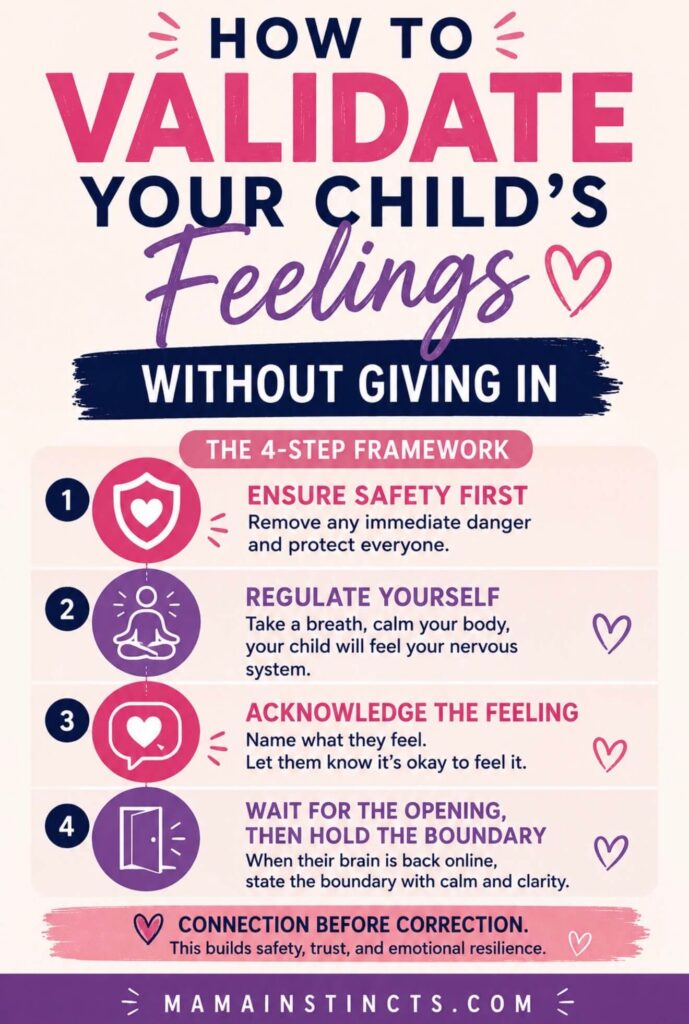
When your child is in the middle of a big emotional moment, having a simple sequence to come back to can be the difference between escalating the situation and de-escalating it. Here is the four-step framework I shared on Great Day Washington, and the one I come back to in my own home.
Step 1: Assess the Situation and Remove Any Immediate Danger
Before anything else, make sure everyone is physically safe. If something needs to be moved, if children need to be separated, if a dangerous object needs to be removed, do that first, calmly and without escalating. Safety always comes before the conversation.
There are moments where the boundary needs to be stated immediately, where you do not have the luxury of waiting. If your child is about to run into traffic, you act first. If siblings are hitting each other, you separate them first. The emotional processing happens after the immediate safety concern is handled, not before.
Safety comes before conversation; always.
Step 2: Check In With Yourself
This is the step that changes everything, and it is the one most parents skip entirely because the instinct is to fix the child first.
Before you focus on your child, take a few deep breaths. Check in with your own body: Is your jaw tight? Is your voice sharp? Is your chest tense? Are you activated?
Your child will feel your nervous system before they hear your words. Children are extraordinarily attuned to the emotional state of the adults around them, they have to be, because for most of human history, reading the adult’s emotional state was a survival skill. If you come in dysregulated, your child’s nervous system reads danger and escalates further.
You do not need to be perfectly calm, that is not a realistic standard and not a helpful one. You just need to lower the intensity enough to create safety instead of adding to the storm.
Simple regulation techniques for parents:
- Take one slow breath before you speak.
- Soften your shoulders and unclench your jaw intentionally.
- Lower your voice instead of raising it.
- Move slower than you feel like moving.
- Silently remind yourself: my child is not giving me a hard time, they are having a hard time. This is not a personal attack against me.
Step 3: Acknowledge the Feeling First
Once you are grounded enough to respond, the first thing you do is acknowledge, not correct, not explain, not redirect. Just name what you see and reflect it back without judgment.
Something as simple as “I can see you’re really upset” or “that felt really big, huh” tells your child’s nervous system that they are safe with you, and that is what opens the door.
You do not need to agree with the behavior to acknowledge the feeling. You do not need to have the right words. You just need to be present and honest about what you are witnessing.
Validation phrases that work:
- “I know this feels really hard.”
- “I can see you’re really disappointed.”
- “I hear you.”
- “I know you really wanted that.”
- “It makes sense that you’re upset.”
- “I’m right here with you.”
Here’s the part worth sitting with: this step might take a few minutes, or it might take longer. Your child’s nervous system cannot calm down on command, it comes down gradually, through your presence, through co-regulation, through feeling genuinely seen. That is not a sign the process isn’t working, that is the process working exactly as it should.
The goal is not for your child to stop being upset, the goal is for them to move through their emotions with you beside them.
Children are not supposed to be happy all the time, and trying to get them there as quickly as possible actually skips the most important part of the process. Feelings are not problems to be solved, they are experiences to be moved through, and your steady presence is what makes that possible. A child who learns to move through hard emotions with support becomes an adult who knows how to do it on their own.
Step 4: Wait for the Opening
You will feel it when it comes: a shift in their body, a slower breath, a softening, their shoulders drop, the crying changes quality, or they make eye contact again… that is your signal that the thinking part of their brain is coming back online and they can actually hear you now.
This is when the boundary lands! This is when the learning moment becomes possible, not in the middle of the storm, but here, once the door is open.
Holding the boundary after acknowledgment sounds like:
- “It’s okay to be upset. The answer is still no.”
- “You can be angry. I won’t let you hit.”
- “I know you’re disappointed. It’s still time to leave.”
- “I hear you. We’re still doing this.”
And once they are calm and connected, that is when you can teach, problem-solve, and practice what they can do differently next time. Children learn best when they feel safe, not when they are overwhelmed.
The sequence is: acknowledge first, wait for the shift, then respond. That sequence is what builds safety, and safety is what makes everything else possible.
What This Looks Like by Age
Toddlers (Ages 1-3)
Toddlers are in the earliest stages of emotional development. They do not yet have the language or brain development to regulate themselves, which is why meltdowns can feel so extreme. With toddlers, less language is almost always better.
- “You’re so frustrated right now.”
- “I’m right here.”
- “That felt really big.”
- Get down to their level, make gentle eye contact, speak softly
- Offer your physical presence before any words at all
Preschoolers (Ages 3-5)
Preschoolers have more language but still very limited regulation capacity. They are beginning to understand that feelings have names, and naming feelings for them is incredibly powerful.
- “You really wanted to keep playing and now it’s time to go. That’s disappointing.”
- “Your body is so upset right now. Let’s take a breath together.”
- “I can see how mad you are. I’m going to stay right here with you.”
School-Age Children (Ages 6-11)
School-age children can engage in more conversation, but not during the height of the emotion. Wait for the shift, then talk.
- “I can tell you’re really frustrated. I want to hear about it when you’re ready.”
- “It makes sense you’re upset. I would be too.”
- “I’m not going anywhere. Take the time you need.”
- “Once we’re both calm, let’s figure this out together.”
Tweens and Teens
Tweens and teens need validation perhaps more than any other age group, and yet they often receive it least, because their big emotions can feel more like a personal challenge to the parent. Resist the urge to correct immediately; your relationship is the leverage.
- “That sounds really hard. I’m glad you told me.”
- “I hear you. I’m not dismissing what you’re feeling.”
- “I get why you’re angry. And we still need to talk about what happened.”
- “You don’t have to agree with my decision. I do need you to respect it.”

Common Mistakes Parents Make (And What to Do Instead)
Trying to reason during a meltdown
Explaining consequences, reminding them of the rule, or asking “why did you do that?” during the height of the emotion is not going to land. The thinking brain is offline, so wait for the opening first.
Talking too much
More words do not create more understanding when a child is flooded. A simple “I see you, I’m right here” is more powerful than a five-sentence explanation. Less is almost always more during a big emotional moment.
Mistaking validation for permissiveness
Saying “I understand you’re upset” is not the same as removing the boundary. You can hold both empathy and consistency at the same time, and doing so is actually what teaches children that feelings are okay and that limits still exist.
Expecting children to calm down immediately
Co-regulation takes time. The nervous system does not reset on command; some children need five minutes, some need twenty. Your patient presence is the tool, not the speed of resolution.
Losing your own regulation
If you are flooded, you cannot co-regulate your child. Your nervous system is contagious in both directions. This is why Step 2, checking in with yourself, is not optional but a must!
Trying to fix the feeling
The instinct to fix is loving, but feelings do not need to be fixed; they need to be felt and moved through. Trying to cheer a child up, minimize what happened, or pivot too quickly to the silver lining skips the acknowledgment that actually helps them regulate.
The Research Behind This Approach
This framework is not just a parenting philosophy, it is grounded in decades of research across multiple fields.
Below you will find the key researchers and works that inform this approach, and if any of it resonates with you, each one is worth exploring further.
Dr. Dan Siegel and Dr. Tina Payne Bryson, authors of The Whole-Brain Child and No-Drama Discipline, describe the importance of connect then redirect: meeting the emotional brain first before engaging the thinking brain. Their work on integration, bringing the different parts of the brain into cooperation, is foundational to understanding why the sequence of this framework matters.
Dr. Bruce Perry‘s neurosequential model emphasizes that the brain must be regulated before it can learn. He has written extensively about how early relational experiences shape the developing stress response, and why safety and co-regulation must come before any cognitive intervention.
Dr. Becky Kennedy of Good Inside has brought much of this research into everyday parenting language, particularly around the concept of being a good inside parent: one who holds firm limits while staying connected to the child underneath the behavior.
Dr. Mona Delahooke, author of Beyond Behaviors, focuses on understanding behavior as a signal of a child’s neurological state rather than an intentional choice, and advocates for bottom-up approaches (starting with the nervous system) rather than top-down approaches (starting with behavior management).
The Harvard Center on the Developing Child provides the serve-and-return framework and extensive research on how responsive caregiving literally builds brain architecture in the early years. Their work on toxic stress also demonstrates the long-term consequences of a child consistently feeling unseen or emotionally unsafe in their relationships.

Frequently Asked Questions
Isn’t validation just telling kids that bad behavior is okay?
No, validation acknowledges the feeling, not the behavior. You can tell a child that their anger makes sense while also telling them they cannot hit. Those two things are not in conflict.
What if my child uses their emotions to manipulate me?
Children rarely manipulate in the way adults mean when they use that word. What looks like manipulation is almost always a child who has learned that a certain level of emotional expression is the only thing that gets them heard. The solution is not to stop acknowledging feelings, it is to consistently respond to lower levels of expression so the child learns they do not have to escalate to be heard.
My child just keeps crying no matter what I say. Am I doing something wrong?
No, some children take longer to regulate than others, and some situations carry more emotional weight. Your job is not to stop the crying quickly, it is to stay present and calm through it. The regulation happens through your presence over time, not through the perfect phrase.
What if I lose my temper and react before I validate?
Then you repair. You come back and say “I got frustrated earlier and I didn’t handle that the way I wanted to. I’m sorry. I love you.” Repair after rupture is one of the most important things you can model for your child, because it teaches them that relationships can survive hard moments and that taking responsibility is something adults do too.
Does this work for all ages?
The core process, regulate yourself, acknowledge the feeling, hold the boundary, wait for the opening, applies across all ages. The language and specific phrases adapt by developmental stage, which is exactly why the free printable below is organized by age group.
Free Printable: Validation Phrases by Age Group
Download the free printable below for a full list of validation phrases organized by age group: toddlers, elementary-age children, tweens, and teens. Print it out, put it on your fridge, take a photo of it for your phone, and reach for it the next time you need a place to start.
The Bigger Picture
The goal of all of this is not perfect parenting, it is not a child who never melts down or a parent who never loses their cool. The goal is a relationship where your child knows, in their body, not just their mind, that their feelings are safe with you, that you will not crumble under the weight of their emotions, and that your love for them does not depend on how well they hold it together.
That kind of safety is what allows children to take emotional risks, to try to regulate, to recover faster, and to eventually internalize the skills you have been modeling for them all along.
You are not just managing behavior, you are building a relationship they will carry with them for the rest of their lives, and every time you choose to acknowledge the feeling before you correct the behavior, you are adding to that foundation.
That is not giving in; that is building something that lasts!
Leave a Reply