You’re feeling a little off. You’ve missed your period, you pee on a stick, and your suspicions are confirmed. You are pregnant! You’re over the moon excited and completely freaked out at the same time. You share the news with your partner and your family.
You quickly realize you need to download an app to track your pregnancy and learn every single thing your fetus might be doing at any given moment. You book an appointment with your OB-GYN, buy What to Expect When You’re Expecting

You keep a running list on your phone of all the things you can’t do and especially what you can’t eat. You run away at the sight of sushi. You follow all the rules because you want to give this baby the best possible start in life.
Nine months later plus or minus, you give birth to the most beautiful baby you’ve ever seen. You know you’re high on birth hormones because you find this bloody, vernix covered little human absolutely perfect, and the amniotic fluid somehow smells like roses. You’re in baby bliss. All is right with the world.
A few weeks go by, and suddenly the advice starts pouring in.
“It’s okay to let her cry.”
“She needs to learn to fall asleep on her own.”
“She’s just manipulating you.”
But here’s the thing.
This baby grew inside your body for nine months. She never heard loud noises, never felt cold, never felt hunger, and was never alone. She was always warm, always held, always safe. And then suddenly, everything she has ever known is gone.
From a biological perspective, babies are born completely dependent on their caregivers. Their nervous systems are immature, and they rely on adults to help them regulate stress, fear, and discomfort.
It is normal for a baby to want to be held.
It is normal for a baby to cry when she’s alone.
This world is big and overwhelming, and mom and dad are all she knows.
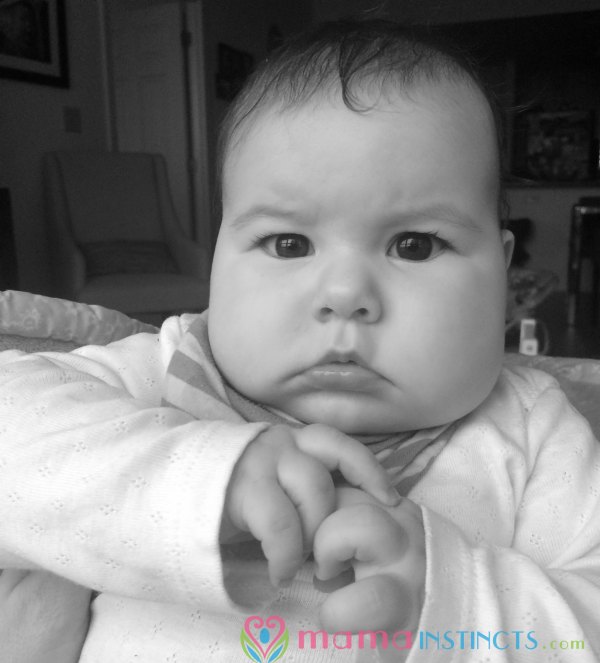
Babies can’t talk, so babies cry. They cry to communicate.
They cry to tell you they’re hungry, uncomfortable, soiled, tired, scared or simply because they want to be close to you. Whatever the reason, it doesn’t matter. What matters is that you respond. When you respond, you’re telling your baby, I hear you. You matter. You’re safe.
She’s not manipulating you. She’s not trying to annoy you. She’s trying to survive and adjust.
You took such great care of this baby while she was growing inside your body. It makes sense to continue doing so once she’s in your arms. Eating a piece of sushi or a cold cut sandwich during pregnancy is far less harmful than repeatedly ignoring your baby’s cries.
Yes, there will be times you can’t get to her right away, like when you’re using the bathroom, driving, or tending to another child, and that’s okay. Babies don’t need perfection. They need consistent love.
When you can respond, holding her, talking to her, or simply being close helps her nervous system calm down.
Don’t let her cry to “teach her a lesson”.
She’s just a baby.
She needs you.
Babies cry for a reason, not because they’re using you.
And here’s something that often gets misunderstood: responding to your baby does not make her more dependent.
Research on attachment shows the opposite. Babies whose needs are met consistently tend to feel more secure, and secure children grow into more confident, independent individuals over time.
If a baby cries and no one responds, she may eventually stop crying, but not because she’s learned a healthy skill. She stops because her body adapts to stress by shutting down. Is that really how we want babies to learn about the world? If you were so careful during those nine months of pregnancy, why would you suddenly stop listening to your instincts now?
You are her mama. Or her papa. Or her caretaker.
You are her safe place. You are all she knows.
Follow your instincts. Your baby depends on you.
I know some days feel long and the exhaustion is real. Take breaks, ask for help and put the baby down safely when you need a moment. Caring for yourself matters too. Responsive parenting doesn’t mean ignoring your own needs; it means doing the best you can with the support you have.
But don’t give up on your baby when she’s asking for you. She’s asking for reassurance in a brand new world.
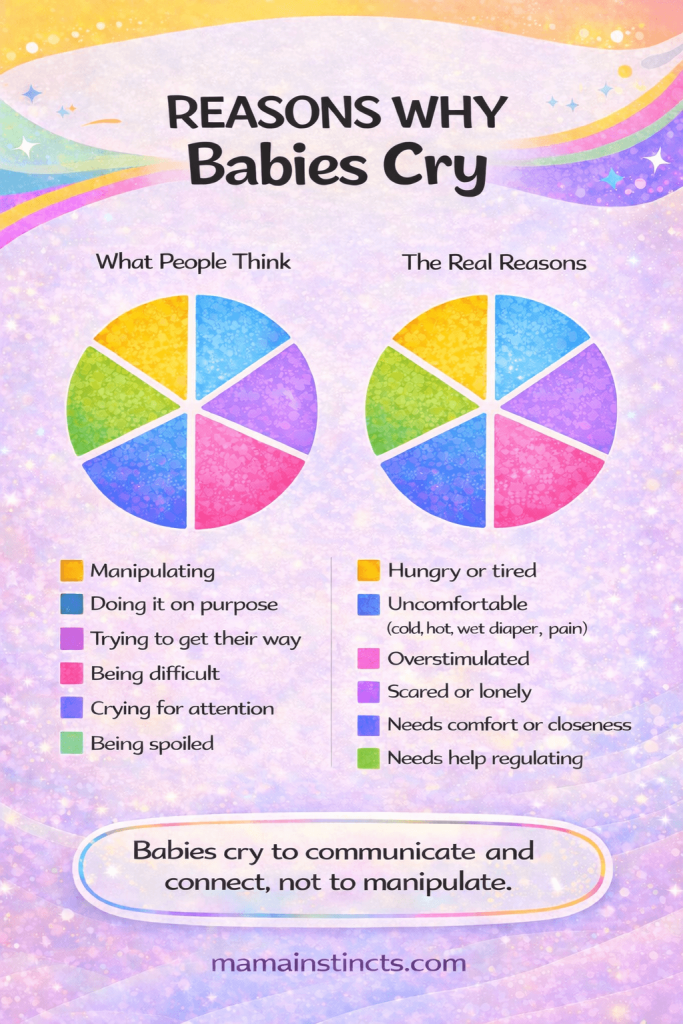
What Science Tells Us About Babies Crying
Science strongly supports what many parents instinctively feel. Babies cry to communicate, not to manipulate.
Newborns and infants are born with immature brains and nervous systems. They cannot self soothe or regulate stress on their own. Crying is their primary and often only way to signal that they need help. According to the Harvard Center on the Developing Child, responsive caregiving in early life plays a critical role in healthy brain architecture and emotional development.
When a baby cries and a caregiver responds, stress hormones such as cortisol begin to decrease. The baby’s heart rate slows, their body relaxes, and their nervous system returns to a calmer state. This process is known as co regulation, and it is how babies learn emotional regulation later in childhood.
Attachment research, pioneered by John Bowlby, shows that babies who experience consistent, responsive care develop what is known as secure attachment. Securely attached children are more likely to explore their environment confidently, manage stress better, and form healthier relationships later in life.
One important takeaway from research is that babies don’t need us to understand every cry. Even when caregivers can’t identify the exact reason for the crying, responding with presence, holding, rocking, or speaking softly, still provides measurable benefits. Studies show that a caregiver’s responsiveness alone can significantly reduce infant stress levels.
On the other hand, prolonged or repeated unresponsiveness can increase stress in babies whose brains are not yet equipped to manage it. The American Academy of Pediatrics emphasizes that responding to an infant’s cries supports emotional security and does not spoil a baby.
In simple terms, babies cry because they need help, not because they have an agenda.
You don’t have to interpret every cry perfectly; you just have to show up. Each time you answer your baby’s call, you’re helping wire their brain for trust, safety, and resilience.
And that matters for a lifetime!
Babies don’t manipulate. They communicate.
Our job is to help them adjust to this new world in a loving, responsive way.
And it starts by listening to their call.
You can do this.
Listen to your mama instincts.
Editor’s Note:
Every family is different, and parenting looks different depending on support systems, mental health, work demands, and cultural expectations. This article is not meant to shame parents who struggle or who make different choices. It is meant to reassure parents who feel instinctively pulled to respond to their baby, even when others tell them not to. Trust yourself, seek support when needed, and remember that loving, responsive care is never harmful.
—
If you enjoyed this post, you’re going to love these too:
- Don’t Leave Me Crying, Mama
- Don’t Tell Me To Let My Baby Cry It Out
- Don’t Want Anyone Holding Your Baby? Here’s Why That’s Normal
I love this post! It devestates me when I hear mama’s say that they let their babies cry! It always breaks my heart for the baby. Crying is the only means of communication that a baby has. Every single cry needs to be answered, they cry because they NEED something. I just don’t understand how they can sleep at night knowing that they didn’t do absolutely everything in their power to make sure all of their child’s needs were met.
I am so glad you are posting about this. I hope that this kind of thinking spreads, and reaches the minds of the parent who “let their baby cry”. Because no baby deserves the cold shoulder.
Melanie
Themakingsoflife.com
Hello Melanie,
Thank you for your comment. I feel the same way you do about this topic and although I will never tell a parent what to do, I don’t understand how can anyone leave their child crying. I do hope more awareness is spread that babies are not manipulation us but just trying to communicate.
I know this comment is years later but wondering if you have any suggestions for how to make my partner stop letting our baby cry. He insists on letting her cry to “tire herself out,” and I just don’t believe that’s a “thing.” Ugh, it makes me never want to leave him alone with her bc I feel like the second she starts crying hell just leave her be instead of holding her. Should I just leave him? Lol, kidding!! (Sorta).