You ask your child to do something simple. Put on shoes, stop the game, come to the table. And instead of moving, they plant their feet and say it.
“No.”
Something in you tightens…
Maybe it brings back memories of being told you weren’t allowed to talk back, maybe it feels like a challenge, like if you don’t win this moment you’ve lost something bigger, or maybe it’s just one more thing in a day that already had too many.
But here is something I want you to sit with before the next no happens in your house:
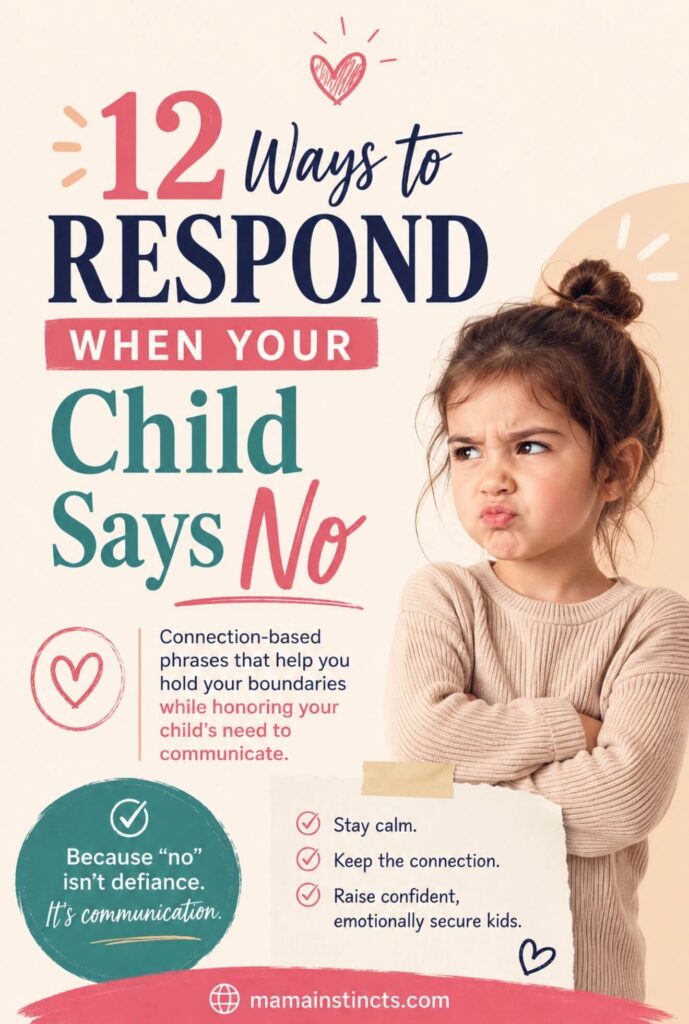
“No” is not defiance; it is communication.
It is often the only tool your child has for expressing a need, a feeling, or a limit they can’t yet put into words. And the response you choose in that moment, the one you reach for without thinking, can either escalate the power struggle or de-escalate it completely.
To be clear, I am not telling you to let go of your boundaries, I am telling you there is a way to hold them that doesn’t turn every single day into a fight.
Why They Say No So Much
Somewhere around 18 to 24 months, your child starts to understand something enormous: they are their own person, separate from you, with their own preferences, their own body, their own will. That understanding doesn’t fade after toddlerhood, it just shows up differently as they grow, through preschool, through elementary school, through the teenage years.
A power struggle was never really about the shoes, or the broccoli, or the iPad; it is autonomy meeting urgency. Your child wants some say over what happens to them, and you need the day to keep moving. When those two needs collide, “no” is what comes out.
This is why your child can say no to something they wanted five minutes earlier; it was never about the thing itself, it’s about whether they get a voice in what happens to their own life.
And here’s what I want you to know, what I have seen play out in my own home over and over again: when we respond with steadiness instead of force, we are not letting them win, we are teaching them that their feelings are safe, that disagreement doesn’t have to break a relationship, and that love and boundaries can exist in the same moment.
Why Responding This Way Actually Matters (The Research)
This isn’t just a gentler approach, it’s a more effective one, and the research backs it up.
The Harvard Center on the Developing Child describes something called “serve and return,” the back-and-forth exchanges between a parent and child that literally shape how the brain develops. Every time your child reaches out, through words, through behavior, through a “no,” and you respond in a way that feels safe and attuned, you are building neural connections that support emotional regulation, stress response, and resilience. The opposite is also true: repeated experiences of being overpowered, shamed, or shut down teach the nervous system that conflict is dangerous and that big feelings are not safe to have around the people who are supposed to help.
Psychologist Erik Erikson identified autonomy as one of the core developmental tasks of early childhood. When children feel like they have no say in what happens to them, they don’t just comply, they either shut down or push harder. Offering real choices within boundaries isn’t giving in, it’s working with how your child’s brain is actually wired at this stage of their development. If you want to go deeper into how children develop their sense of self and why it matters so much in the early years, Erikson’s stages of psychosocial development are worth understanding.
Dr. Dan Siegel, whose work on interpersonal neurobiology has shaped so much of how we understand parent-child relationships, talks about the importance of “name it to tame it,” the idea that when we help children put language to their emotions, we help the thinking brain (prefrontal cortex) come back online after the emotional brain (amygdala) has taken over. Several of the phrases in this post do exactly that!
If you want to read more about how the brain works in these moments and what parents can do to support their child’s emotional development, Dr. Siegel’s work is one of the best parenting books you’ll ever read! His content is very accessible, easy to understand, research based and practical. I highly recommend reading both “The Whole-Brain Child” and “No-Drama Discipline” by Daniel J. Siegel and Tina Payne Bryson!
But What About When You’re Triggered Too?
Here is the part nobody talks about enough…
You can read every phrase on this list, memorize them, write them on a sticky note on your fridge, and still find yourself in the middle of a standoff saying something completely different. Not because you don’t care, not because you haven’t learned enough, but because your own nervous system fired before your brain caught up.
That is not a failure; that is just how humans work.
When your child says no and something in you tightens, that tightening is your own stress response activating. If you grew up in a home where defiance wasn’t tolerated, where your no was met with anger or punishment, your body learned a long time ago that this moment is threatening. That learning doesn’t disappear just because you’ve decided to parent differently, it shows up anyway, in the heat of the moment, before you even have time to think.
So before any of these phrases can work, you have to be regulated enough to use them. That means pausing, even for just a few seconds, taking a breath, and giving your own nervous system a moment to come down before you respond. It means accepting that you will not always get it right, and that repair after a hard moment matters just as much as the response in the moment itself.
This is a practice, not a performance. The goal is not to be perfectly calm every time; the goal is to keep coming back to connection, even after you’ve lost it.
What to Say When Your Child Says No
Before we get to the phrases, there is something more important than any word on this list: your tone and your energy when you say them. Children are not listening to your words as much as they are reading your body, your nervous system, your energy in the room.
You can say every single one of these phrases perfectly and they will fall flat if you are tense, frustrated, or running on empty. None of this works if you are not calm first. So before you say anything, take a breath, soften your shoulders, and get yourself regulated. The words are just the vehicle; the calm behind them is what actually reaches your child.
Every child is different, so these phrases might not work exactly as written for yours, but use them as a starting point and adapt the tone and approach to fit your family.
Here are 12 phrases you can use:
“You don’t want to right now. Tell me what’s making this hard.”
Why this works: It shifts you from correcting to understanding. So often what looks like defiance is your child trying to communicate something they don’t have the words for yet, and getting curious instead of reactive changes the whole dynamic.
“I hear you. It’s okay to feel that way, and it’s still time to ___.”
Why this works: You are validating the feeling while holding the boundary. Feelings and responsibilities can live in the same sentence, and your child needs to learn that early. They learn this best from watching you do it.
“You can say no, but this is something that still needs to happen.”
Why this works: Calm, clear, no debate required! You’re not making them wrong for having a reaction, you’re just naming what’s true without adding drama to it.
“Let’s figure out a way to make this easier.”
Why this works: Instead of forcing it, you invite them in. This one little shift, from power struggle to shared problem, can change the entire direction of the moment.
“You wish you could keep playing.”
Why this works: Sometimes the most powerful thing you can do is simply name what’s underneath the no. You don’t have to change your answer to let your child know you understand them, and feeling understood is often what softens the resistance.
“Would you like to do it yourself, or would you like my help?”
Why this works: A real choice inside the boundary gives them a sense of control without giving up the expectation. It meets their need for autonomy directly, which is usually what the no was about in the first place.
“Would you like to do it now or in two minutes?”
Why this works: A little control over timing can be the difference between a meltdown and a yes. You’re not negotiating whether it happens, just when, and that distinction matters more than it might seem.
“I’m listening. What would you like instead?”
Why this works: This teaches negotiation and communication. You’re not caving to every request, but you are showing them their voice matters and there’s a respectful way to use it.
“It’s okay to be upset. I’ll help you through it.”
Why this works: Staying calm and connected through resistance instead of matching their intensity is co-regulation in action, and it’s one of the most important things you can offer your child in a hard moment.
“Let’s do the first part together.”
Why this works: Big or overwhelming tasks can trigger resistance simply because they feel like too much. Break it down, do the first piece together, and watch the resistance soften.
“When you’re ready, we’ll get started.”
Why this works: This reduces pressure while still holding the expectation. You’re giving them a moment to gather themselves, not an exit from the boundary.
“I won’t argue with you, but I will help you follow through.”
Why this works: Calm, firm, present. You’re not pulled into the debate, and you’re not walking away either. It communicates that you’re steady, and steadiness is what helps a dysregulated child come back down.

What We’re Really Teaching in These Moments
None of these phrases are about getting your child to comply faster, they never were.
They are about something bigger: teaching your child that “no” can be heard without being feared, and that boundaries and connection can exist together.
And before anyone thinks this means letting kids do whatever they want, let me be clear:
That is not what this is.
- Your child still does the task.
- They still follow through on the expectation.
- Talking to you disrespectfully is still not okay.
What changes is how you get there!
Holding a boundary and validating a feeling are not opposites; you can say yes to the emotion and still say no to the behavior, and that is not permissive parenting. That is parenting that sees the whole child, not just the surface of the moment.
The child who learns this from you will grow into the adult who knows how to set a boundary without losing the relationship, who can hear no without falling apart, and who knows their voice matters without having to fight for it. That skill will serve them for the rest of their life, and it starts here, in this ordinary moment, with the shoes, with you.
If you’re noticing the no’s have gotten bigger lately, louder, more frequent, especially at the end of a long day, that is often a sign your child’s emotional cup is running low rather than a sign that something is wrong with your discipline. I wrote more about what it means to fill your child’s emotional cup and why it matters so much, because connection is usually the missing piece before any phrase will actually land.
And if the no comes out sharp, or sarcastic, or with an edge that feels like disrespect rather than simple resistance, that’s worth understanding too. I wrote a full guide on what to say when a child is being disrespectful, broken down by age, because disrespect and defiance often come from very different places, even when they sound the same in the moment.
The Bigger Picture
You came here because you want to do better, because you’re paying attention, because somewhere in you there is a deep belief that the relationship matters more than winning the moment.
That already says everything about the kind of parent you are!
The next time your child says no, you don’t have to be perfect. You just have to pause, take a breath, and choose connection over control, even imperfectly, even when it’s hard. Some days you’ll get it right from the start, some days you’ll lose it and have to come back and repair, and both of those things are part of the same practice.
What you’re building here, one ordinary moment at a time, is a child who knows their feelings are safe, who trusts that you can handle their hard emotions without falling apart or shutting them down, and who is learning every day what it looks like to hold a boundary with love.
You don’t have to win the no.; you just have to keep showing up, keep coming back, and keep choosing the relationship, because that is what they will remember long after the shoes finally get put on.
That is not losing your authority, that is building the kind of relationship that lasts. 💜
Leave a Reply